Showing posts with label Russia. Show all posts

Monday, August 1, 2011

Petersburg's In-Between Spaces


There’s a particular kind of daytime snoozing that I associate with the summertime in St Petersburg – a half- conscious, shallowly immersed, dream-state in which fragments of the surrounding environment and snatches of recent experience float and mingle and expand and contract. I didn't have so much cause to practice submitting myself to this art of lucid dreaming on this visit – for one, the curtains of my room were thicker and more effective at blocking out the midsummer white nights—but the couple of times I have surrendered to a daytime nap, the experience is as vivid as ever. I’m sure this state arises from a combination of the unrelenting daylight, the suspension in a foreign city’s bustle, and the foreign language’s rustle all around and inside. On this trip, at least, I felt some sounds and shapes of Russian a little more internalized than previously. Could this have anything to do with my newly attuned musical ear…? Of course, I’d like to think so, but who’s to know.
In my last week in Petersburg, I went to a concert of organ and cello music. The street address on Sadovaya gave little away about the actual location – it turned out to be set way back from the street, in the grounds of the Suvorovskii-Military Academy, in the Maltese Chapel.
[A Maltese Chapel in Russia? I had no idea…but it turns out that Paul I, son of Catherine the Great, had been made the Protector of the Order of the Maltese Knights of St John in 1797. Paul had grown up reading stories of knights of old, and he went on to develop a particular interest in things chivalric: he endeavoured (with no success or popularity) to reinstitute the honor of the old chivalric orders as an antidote to what he perceived as Russia's corrupt aristocracy. In Petersburg, city of royal palaces, it is a castle--Mikhailovsky Castle--complete with drawbridges and armored knights in relief on its front walls--that was Paul's residence. The Knights of St John were connected to the grail, and ss for the Maltese Chapel--and tales of knights that played on my own childhood imagination--I have to admit that something about the chapel's facade--which you come upon suddenly in a hidden courtyard, seamlessly joined to other buildings--reminded me of Indiana Jones and the Last Crusade and the grail temple carved into the rock (filmed at Petra in Jordan).]

The Maltese Chapel at Sadovaya 26, embedded in the Suvorovskii Military Academy


But I digress…Russian tsars…Indiana Jones…ah yes, Vivaldi…To my delight, among the pieces they played was the Vivaldi cello sonata in Eb minor – one of the sonatas that I had played. This was a new experience for me – hearing something that I knew (and knew only through playing –not something I was already familiar with as a listener). Both this novelty and, perhaps, the very nature of this particular music – the clarity of its phrase structures – made for a different kind of listening experience – one where I was as aware of every note as of the unfolding movement of the whole. Listening to the clear line of the cello was like hearing it draw out of me something that I held whole inside myself. Like knowing the words of a play--not just glancingly familiar but deeply internalized—that you see acted before you.
The semi-conscious lucid dreaming is just one of St Petersburg’s in-between spaces. In this transitional society--definitely still transitional 20 years after the end of the Soviet Union--building work, repair and remodeling are going on everywhere, and building-use, commercial activity and consumer behavior are all in a state of flux. I had two particularly striking experiences of Petersburg's in-between spaces that seemed very much typical of the city's current condition and evolution. It is probably no coincidence, either, that they were both in the company of my young friends -- who have degrees in interior design and environmental design, a specialty that also belongs to and finds much application in today's Petersburg.

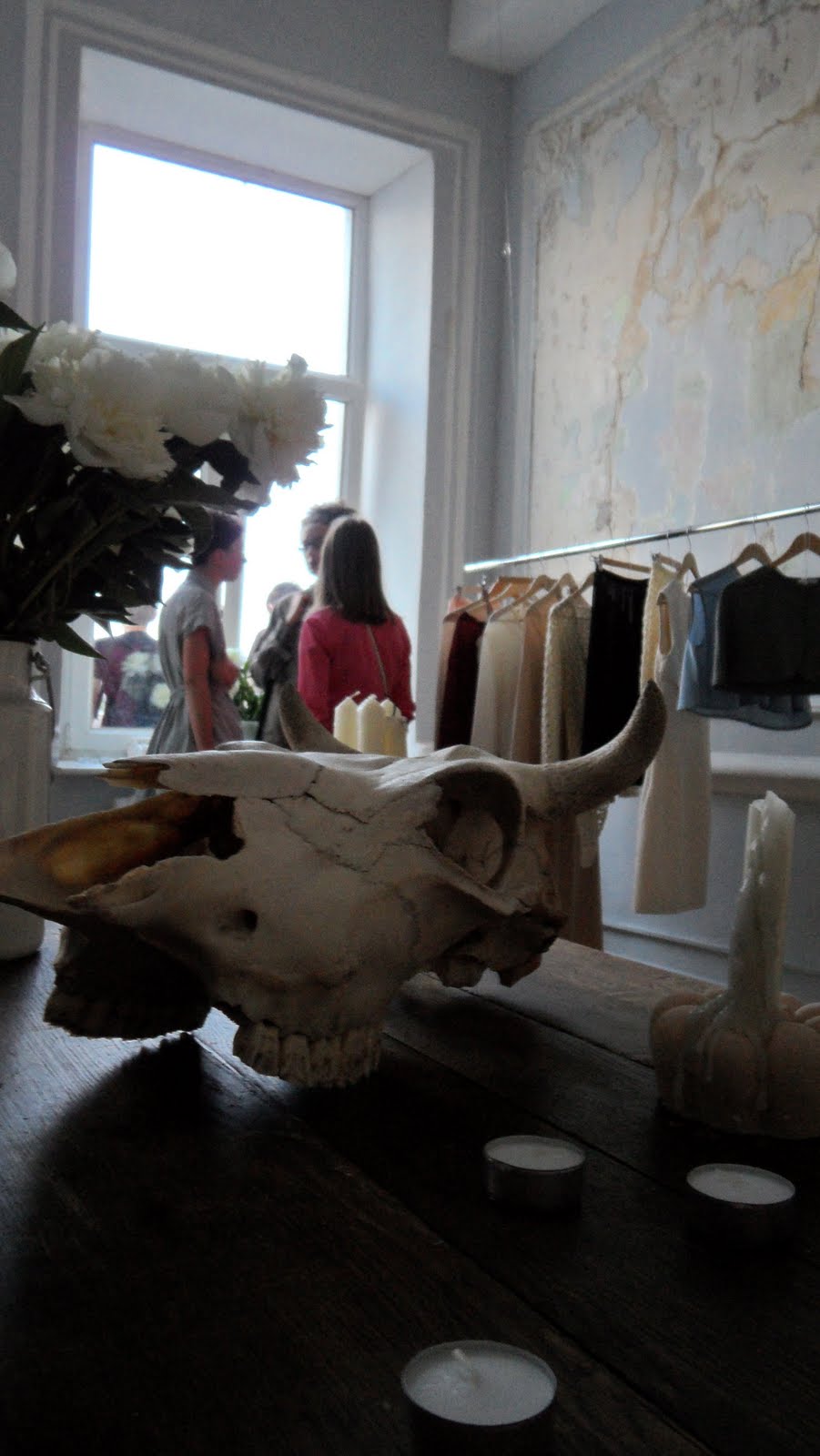
The first was a house -- an unrestored osobniak -- on the embankment right next to the Hermitage. The house was up for sale, but, thanks to its prestigious location and size, at such an enormous cost that it was hardly likely that a buyer would be swiftly forthcoming. So, in the meantime, it was being rented to group of young designers and artists who used the large empty rooms as exhibition and studio space. On my first night in Petersburg, I found myself on its balcony staring right across at the gold spire of the Peter and Paul Fortress against the midnight dusk sky. A party was being held to celebrate one young woman's fashion collection; the clothes were displayed against the flecked walls of peeling plaster, and some time after midnight were hoisted to ceiling-height to make more room for dancing. A couple of weeks later, my interior designer friends took me to their studio. An entrance from the street led up a dingy staircase; we were let into one door and led through a long twisting, high-ceilinged corridor, hung with sheets, and between the seams, every now and then, you could see the building pared down to its bare structural form -- way beyond even the shabby chic of the make-shift fashion exhibition, completely uninhabitable. Then, suddenly, the corridor ended and opened into a large double-sized studio, with beautiful wood floors, fresh paint and all new fixtures. The windows looked onto the yard, and I was completely disoriented as to which way we now faced compared to where we had entered. What will these in-between spaces, and the spaces they are between, have become in another five or ten years, I wonder?




Tuesday, July 5, 2011

Ensemble of Violoncellists of St Petersburg

Somewhere between the trips on vodka-vapoury buses that move at a rate of inches-per-hour and the trips on sleek express trains, where electronic cigarettes guarantee the cleanliness of the air as the kilometers between Moscow and St Petersburg are swallowed up, I have found my way to hear some cellos, and more besides.

First off, right at the bottom of the classical music listings, there was the Ensemble of Violoncellists of St Petersburg. I turned up at the venue, a recently restored Estonian church, with no idea of what to expect. I was vaguely recalling the night, some ten years ago, when I went to a jazz club in Samara: I had been thinking intimate smoky basement -- and I joined orderly rows of audience in a vast hall to listen to a four hour long concert of hopping big band music on a stage hung with a banner proclaiming, Soviet-style, glory to geologists.

(Lest I was overstating the dissolution of all difference between Russian and Western ways in my previous post, let me just say that on the way to the concert I had an amusing experience of Russia's all-too-often flagging (but evolving) culture of customer service: I went into a shop and asked for a bottle of mineral water. The sales assistant pressed some buttons on the till, then--ever so slowly--turned away from me, took up a comb, looked into a small mirror that was hanging on the partition that divided the drinks counter from the dairy products counter, and carefully combed her fringe a few times. She turned slowly back to me, and asked, moodily, "Is that all?")

On entering this cleanly painted, plain wooden Lutheran church just round the corner from the Mariinsky Theatre, we were handed a programme and a pen, with the instructions to rate each piece with points on a scale of one to ten. For an instant, I thought I'd come to see some kind of strange talent contest, and not convinced I'd understood correctly, I asked my neighbour what this was all about. "Just so they know what people like best," she told me. No contest, then -- just a bit of audience engagement.

There were 17 short numbers on the programme -- ranging from Rachmaninov to Chuck Berry, from Ukrainian folk dance to the Pink Panther. The arrangements were pretty great, and the eight cellists were joined by a soprano from the Mariinsky for a few numbers -- including, to my delight, Villa-Lobos' Aria from Bachianas Brasilieras No. 5, which I had stumbled through, piecemeal, in the string orchestra workshop in San Francisco last summer. My other favourite was probably the arrangement of Dizzy Gillespie's Night in Tunis...translated into marvellous jazzy cello riffing... Biased toward the cello I may be, but with that versatility, who needs any other instrument...

I'm not sure I was fully committed to the point allocation aspect of the evening -- but I nonetheless recorded my scores for each number (minimal distinctions between generally superlative responses--an opinion largely shared, my sneaks revealed, with my neighbour, and judging by the hall's response, with most of the audience, too) and dutifully handed in my sheet at the end.

I'd never heard a cello choir concert before, nor a concert with such a varied programme -- and as well as great musicianship, there was also what seemed like a good dose of adventurousness in exploiting the cello's potential. A couple of pieces were a little heavy on the romantic-sentimental side for me, but overall there was something quite refreshing about the whole concert (and which made me think of the conversation some fellow cello-bloggers had had a while back about concert programmes and the profiles of dwindling audiences): moving easily between such a range of genres, these Petersburg cellists quite openly and enthusiastically combined some serious artistry with music's emotional transports and an unabashed experience of entertainment. And as a result, while the music wasn't at all amateur, the feeling of community among the public (of around 80 people, probably) was somehow more akin to my memories of (English) village hall events than to the solemnity and urbanity of a concert hall.

Monday, June 27, 2011

On the Streets of St Petersburg

This post comes to you courtesy of Align Leftwi-fi on board the Sapsan [Peregrin Falcon] express train from Moscow to St Petersburg...amongst whose other high-tech amenities number "electronic cigarettes"-- on sale in the buffet car for those who can't make the four hours...I wonder if these may have been introduced as a precautionary measure after desperate passengers, used to the lengthy stops of regular Russian trains, nipped out for a quick smoke at Tver', only to be stranded on the platform as the speedy Sapsan took silent flight....

Умом Россию не понятъ - You can't understand Russia with your mind, as Tiutchev's words come out rather less pithily in English. But sometimes with your body, perhaps: I walk a lot in my usual life, but why does walking the streets of Petersburg make my foot strangely swell up and my limbs ache with a deep fatigue? The air is filled with traffic fumes, cigarette smoke, and, at close quarters on pavements and in shops, the tragic smell of stale vodka. Yesterday afternoon I bought a slim volume about Shostakovich in an antikvariat bookshop from a man who gave off that familiar odour of toxic vodka tears. Last week, I sat on a bus for almost an hour, stuck in one of Petersburg's many probki (traffic jams) crawling along a few hundred meters of Sadovaya Street to join Nevsky Prospect. This was the very place that, on board a tram in 1918, a chance encounter took place between the poets Zinaida Gippius and Aleksandr Blok. Unable to reconcile herself to Blok's recently published long poem, The Twelve, and its depiction of the revolution, Gippius declared that in public, at least, all relations between them must be severed. The tram stops and Blok gets off. It was the last time Gippius was to see him before his death in 1921. Stuck in today’s city's traffic jams, they would have had time to thrash out the matter further; the probki grant no such fleetingness to encounters aboard public transport.

A man breathing sour vodka vapours sits down next to me. "You have beautiful hands," he says, through the slight thickness of drink. "Veins--that's good--they carry life, you know you are alive." (After the exertion of a walk in the heat, the veinon the backs of my hands were prominently standing out.) He compares his own hand to s mine: almost unnaturally smooth skin covered the puffy reddish hand; I recalled the more extreme bloatedness in the hands and faces of the drunken men and woman--the sight of the women was always more shocking--I used to see hanging around on Ligovsky Prospect near the Moscow Railway Station before a smart new shopping centre was built there. "No veins, you see." He took a call on his mobile phone. When it ended, he complained about a nagging woman, and then, with a hint of ruefulness, added "My daughter -- she took away my car because I drink." The traffic lights at the corner with Nevsky changed several times; we moved nowhere.

The St Petersburg traffic is somewhat calmer and less anarchic than it was six years ago--and not just because it spends most of its time ground to a halt in perpetual traffic jams. Many streets in the centre are now one-way (to make room for parking the rapidly growing number of vehicles at the curb), there are light-controlled pedestrian crossings with reassuringly large green-man walk signs, and, I am told, a new law stipulating that vehicles must give way to pedestrians. Crossing Ulitsa Marata each morning, though, is still something of a gauntlet to run: woe betide the pedestrian who thinks it is for him that the speeding car slows, and not to swerve a gnarly patch of potholes and raised tram-tracks...

I can’t help but wonder, though, how the changes in the traffic rules happened—I mean, in a way, it must have been a change that happened overnight--did they just put up sign and the next morning everyone drove the right way? Did people get it right straight away? Were there chaotic encounters as cars erroneously came nose-to-nose in newly designated one-way streets, or confusions and frustrations as drivers were sent looping round the block one more time…? And does this most banal change—the establishment, one day, of a one-way street, work as something of a metaphor for other processes of change in Russian society…? Now the traffic situation is more or less entirely normalized – as are the other changes most visible to me.

For the young Russian friends (5 years my junior) that I live with, the new normality is seamlessly assimilated: they tell me that clothes from [the English high street store] Marks and Spencer are simple, that bread from the French bakery is good, that a smart phone was really the only upgrade to go for. The five years that separates us in age is not a lot, but it does mean that their adult life began in the mid-to-late 2000s, when the “middle class” had grown, wealth was becoming more evenly distributed after the grotesque extremes of the unstable 90s, and the gap between Russia and western Europe, at least on the most readily observable plane of material existence, had shrunk. Their adult lives had largely been formed in the six years that I had not visited Russia, so the imperceptible assimilation of these new ways was somehow even more striking to me.

"Modernization or Death"

I had first come to Russia in 1998, and in forming my relationship to the place and to people here, the “difference” of the place that I came from had to be dealt with one way or another. Perception of the differences stood behind the interest, openness, good humour, and sometimes exasperation, that came along with experiences of everyday life in Russia. People would often ask about where you lived and what your life was like or how certain things worked—and I remember a feeling sometimes of the sheer impossibility of conveying some of these things—not because any one individual aspect of life was so wildly different, but because the whole picture of life that they formed was an altogether different kind of composition. Now, though, that difference has diminished dramatically, and in my relation to Russia and Russians, I no longer feel so much of that suppressed or under-expressed sense of the gap.

***

The other day I was stopped on the street and asked the way to the Dostoevsky house-museum, and the next day, the way to Pushkin’s apartment on the Moika. I was, of course, able to help these seekers of literary addresses –this layer of St Petersburg remains unchanged in the six years since I was last here--but when I speak and they realize I am not Russian, they laugh good-naturedly at the unlikely foreigner who knows where Pushkin lived…


St Isaac's Cathedral on a White Night, from Canal Griboedova


Friday, June 17, 2011

Travelogue ~ Prologue ~ Prelude

My cello has been left upstairs in the attic room at the top of M.’s house that looks one way onto the San Francisco Bay and the other way onto a wooded hillside that is home to new-born, long-legged prancing deer, sweet-songed orioles, a slinky red fox, nine menacing turkeys, and, occasionally, to the delight of M. the improvising cellist, a partner in nighttime duets, the ever-inventive mocking bird. The hard white case in which M.’s own cello has travelled to Russia, Palestine, Israel, Hungary and elsewhere lives up in this room as well -- and the room itself, with its odd-shaped ceilings and many angles is not unlike a giant cello case of its own. I think my cello will be happy there while I am off on this summer of restless travels. Perhaps, now and then, first thing in the morning, instead of picking up his own 300 year-old cello of dark, wise wood, M. will take downstairs my three-year-old anonymous cello, bought from the man in the subway station, and play Bach on it.

***

Returning to England for the first time in eighteen months, I made the hour’s drive from Heathrow to my parents’ house in Hampshire. After the expansiveness and scale of the American landscape, England always seems cosy and rounded, its features—both natural and built—huddling on an island, not stretching across a continent.

In the past few years of living in the Bay Area, I have found myself, now and then, perceiving the landscape in a more primal way--with some awareness the land and climate that exists separately from all that is built, natural contours and dynamics that exist apart from and prior to the modern life that goes on there. With the bay, the headlands of Marin and San Francisco, the Berkeley hills and the certainty of westerliness that comes with the sun descending into the Pacific, one comes to always be sure of one’s orientation in this place. With so many vantage points from which to admire the view of the bay, one is so often struck by how thoroughly humanly settled the area is and, at the same time, how dynamic and boldly defined its landscape is. (Knowledge of the possibility of earthquakes heightens this sense still more.) And as for the weather, one usually has the feeling that although it is so rapidly variable, it moves in large, wide fronts off the ocean or down the coast and across the land. Sometimes, especially when it rains in huge sheets for hours on end, as it did so much this spring, there’s almost some of feeling of processes that are not just local but that belong to the planet, or a relationship between earth and sky that adheres to geological time, not human time.

As I near my parents’ house in the village of Headley, and in the next few days as I drive to nearby towns, I feel that that habit formed in California to perceive both raw landscape and its relation to human settledness now apprehends something anew about this familiar place. What strikes me is how we really do live in woodland. There are woods all around the houses and villages that are joined by narrow, often deep sunk roads. The dense leafiness that is all around creates a sense of protective proximities, and the possibility of ever being able to see as far into the distance as one might from a window or hillside in Berkeley now seems strange and almost audacious. This sense of proximities has an audible manifestation too: issuing from the woodland is a true chorus of birdsong—not the single voice of an oriole or mockingbird, but a constant and variegated song, a tuneful babble of chirps and whistles and low and clear coos, all woven together and close around, through the kitchen window, like sticks and grasses making a nest of song.

***

Now St Petersburg: the first time here for six years. The same familiar smell of the tap water. My body remembers the odd feeling of encountering the one differently spaced flight of stairs on climbing to the fourth floor apartment on Svechnoi pereulok (Candle Lane). And though the trams are all new, the same rattle that’s felt right through the apartment when they pass along the street below. There have been some cellos in Russia, too (heard not played) but more on those another time.

***

I did fulfil the ambition of playing some Bach by the time I had finished the PhD -- the Prelude of Suite No. 1 --and so I made this recording the week after I had submitted the dissertation. It’s certainly quite crude and patchy, and despite a couple of more overtly botched moments (including, annoyingly, the end), it’s just about palpably whole enough. At the very least, a yardstick by which to measure future and hopefully ever- improving efforts…

Sunday, March 27, 2011

[just wow]

Every so often the musical experience comes along that blows your mind, alters your state of being...tear-inducing and skin-gasm-giving (learned that one from Eddie!). Tonight it was the St Petersburg Philharmonic Orchestra conducted by Yuri Temirkanov and Alisa Weilerstein playing the Shostakovich Cello Concerto No. 1. Preceded by Rimsky-Korsakov's Russian Easter Overture (and followed by Brahms Symphony No. 4 and an encore --hurrah-- from the Enigma Variations, which did something beautiful and delicate at the very end, giving the final pronounced dying note to a violin somewhere at the back). But they had me from the first notes of the Rimsky-Korsakov. The sound of the orchestra was just beautiful -- a completely different experience from the SF Symphony (feel a little bad there resorting to such comparisons). So live -- in the sense that no recording could ever approximate this sound -- a performance that pulls you right there into the present with it, that doesn't just let you listen from the outside, as if through glass or through speakers, but pulls you right there into the music with it.

Lacking much proficient vocab for describing these things, I want to say somehow that their "pronunciation" of the music was different, and that its "posture" was somehow exceptional. Perhaps the pronunciation was the deep and many-sided emotion -- as well as something that I struggle to describe in how the transitions between different kinds of passages seemed to more meaningfully articulated than anything I've heard before. And perhaps the posture is the sense of an unshakable conviction that this was profoundly serious, that the efforts to use all this art form's abundant and varied means for communication and expression and to convey all that these pieces contained -- that these efforts were made with the utmost earnestness and with abandon. In short, I suppose what there was here (or what I was ready to feel) was art, unabashed, unapologetic art.

And, by the time we got to Shostakovich in particular -- art as a matter of life and death, in all its urgency. Weilerstein was tremendous. The Shostakovich concerto is terrifying and ferocious. And so devastatingly subversive. Appropriating music to fit a desired meaning is notoriously fraught (especially in the case of Shostakovich), and although the Soviet authorities found a perfectly acceptable narrative of their own in the concerto, it's impossible not to hear the cello as a biographical subject of the past decades of Stalinist Terror and war that preceded its writing. And that the cello could say what it does with the full support of the ranks, of an orchestra around it -- is somehow visually also deeply subversive. At one point, in one maniacally repeating dance right up high in thumb position, I swear you could actually hear the cello issue a caustic mocking laugh. Even the breaking of a string during the final movement and Weilerstein's departure from the stage to fix it did nothing to diminish the taught, terrible power of the whole. Maybe, like the enigmatic, ambiguous, disturbingly strained "sound of a snapped string" in Chekhov's famously obscure stage direction to The Cherry Orchard, it only enhanced it.