Showing posts with label space and architecture. Show all posts

Monday, August 1, 2011

Petersburg's In-Between Spaces


There’s a particular kind of daytime snoozing that I associate with the summertime in St Petersburg – a half- conscious, shallowly immersed, dream-state in which fragments of the surrounding environment and snatches of recent experience float and mingle and expand and contract. I didn't have so much cause to practice submitting myself to this art of lucid dreaming on this visit – for one, the curtains of my room were thicker and more effective at blocking out the midsummer white nights—but the couple of times I have surrendered to a daytime nap, the experience is as vivid as ever. I’m sure this state arises from a combination of the unrelenting daylight, the suspension in a foreign city’s bustle, and the foreign language’s rustle all around and inside. On this trip, at least, I felt some sounds and shapes of Russian a little more internalized than previously. Could this have anything to do with my newly attuned musical ear…? Of course, I’d like to think so, but who’s to know.
In my last week in Petersburg, I went to a concert of organ and cello music. The street address on Sadovaya gave little away about the actual location – it turned out to be set way back from the street, in the grounds of the Suvorovskii-Military Academy, in the Maltese Chapel.
[A Maltese Chapel in Russia? I had no idea…but it turns out that Paul I, son of Catherine the Great, had been made the Protector of the Order of the Maltese Knights of St John in 1797. Paul had grown up reading stories of knights of old, and he went on to develop a particular interest in things chivalric: he endeavoured (with no success or popularity) to reinstitute the honor of the old chivalric orders as an antidote to what he perceived as Russia's corrupt aristocracy. In Petersburg, city of royal palaces, it is a castle--Mikhailovsky Castle--complete with drawbridges and armored knights in relief on its front walls--that was Paul's residence. The Knights of St John were connected to the grail, and ss for the Maltese Chapel--and tales of knights that played on my own childhood imagination--I have to admit that something about the chapel's facade--which you come upon suddenly in a hidden courtyard, seamlessly joined to other buildings--reminded me of Indiana Jones and the Last Crusade and the grail temple carved into the rock (filmed at Petra in Jordan).]

The Maltese Chapel at Sadovaya 26, embedded in the Suvorovskii Military Academy


But I digress…Russian tsars…Indiana Jones…ah yes, Vivaldi…To my delight, among the pieces they played was the Vivaldi cello sonata in Eb minor – one of the sonatas that I had played. This was a new experience for me – hearing something that I knew (and knew only through playing –not something I was already familiar with as a listener). Both this novelty and, perhaps, the very nature of this particular music – the clarity of its phrase structures – made for a different kind of listening experience – one where I was as aware of every note as of the unfolding movement of the whole. Listening to the clear line of the cello was like hearing it draw out of me something that I held whole inside myself. Like knowing the words of a play--not just glancingly familiar but deeply internalized—that you see acted before you.
The semi-conscious lucid dreaming is just one of St Petersburg’s in-between spaces. In this transitional society--definitely still transitional 20 years after the end of the Soviet Union--building work, repair and remodeling are going on everywhere, and building-use, commercial activity and consumer behavior are all in a state of flux. I had two particularly striking experiences of Petersburg's in-between spaces that seemed very much typical of the city's current condition and evolution. It is probably no coincidence, either, that they were both in the company of my young friends -- who have degrees in interior design and environmental design, a specialty that also belongs to and finds much application in today's Petersburg.

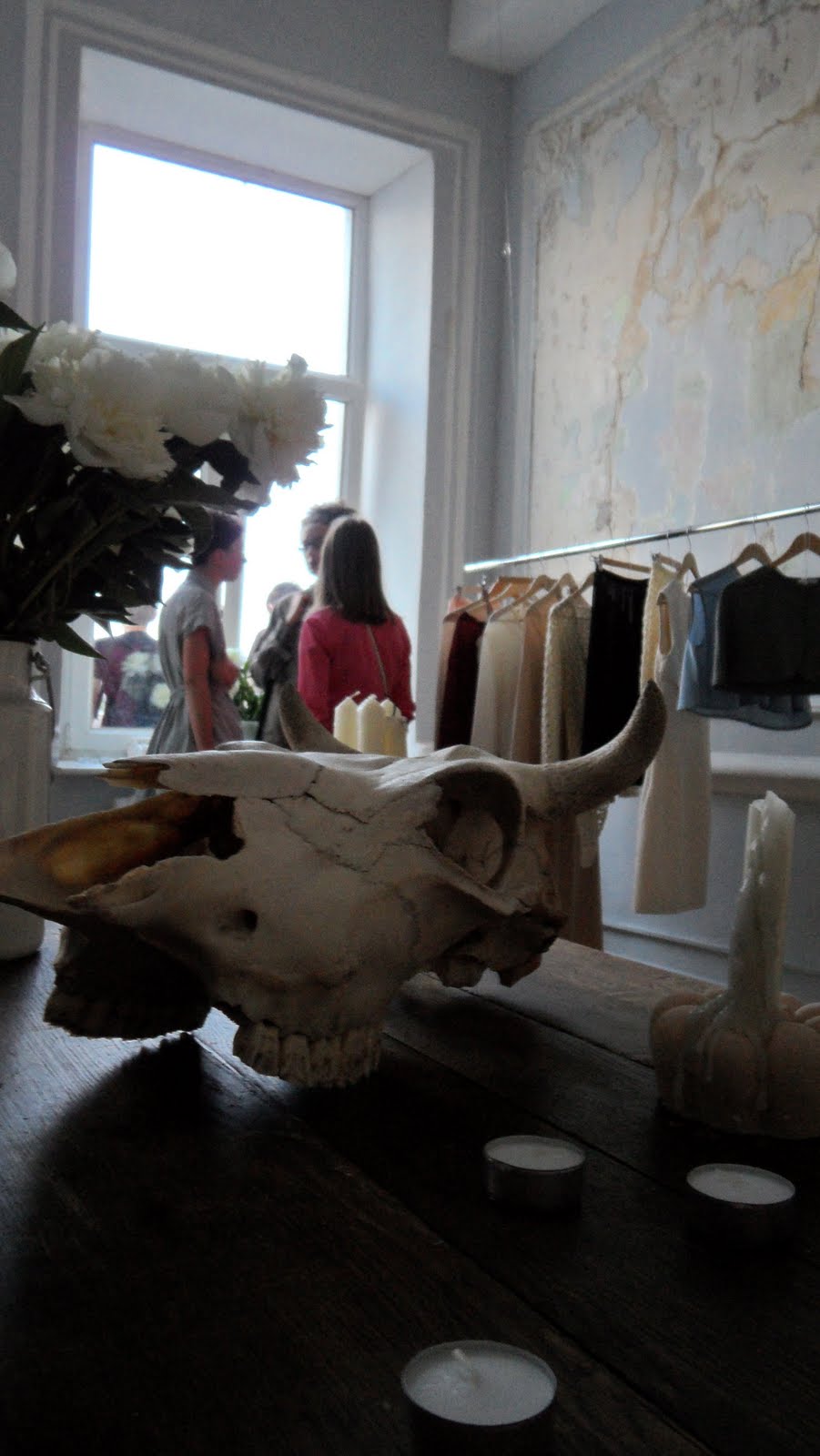
The first was a house -- an unrestored osobniak -- on the embankment right next to the Hermitage. The house was up for sale, but, thanks to its prestigious location and size, at such an enormous cost that it was hardly likely that a buyer would be swiftly forthcoming. So, in the meantime, it was being rented to group of young designers and artists who used the large empty rooms as exhibition and studio space. On my first night in Petersburg, I found myself on its balcony staring right across at the gold spire of the Peter and Paul Fortress against the midnight dusk sky. A party was being held to celebrate one young woman's fashion collection; the clothes were displayed against the flecked walls of peeling plaster, and some time after midnight were hoisted to ceiling-height to make more room for dancing. A couple of weeks later, my interior designer friends took me to their studio. An entrance from the street led up a dingy staircase; we were let into one door and led through a long twisting, high-ceilinged corridor, hung with sheets, and between the seams, every now and then, you could see the building pared down to its bare structural form -- way beyond even the shabby chic of the make-shift fashion exhibition, completely uninhabitable. Then, suddenly, the corridor ended and opened into a large double-sized studio, with beautiful wood floors, fresh paint and all new fixtures. The windows looked onto the yard, and I was completely disoriented as to which way we now faced compared to where we had entered. What will these in-between spaces, and the spaces they are between, have become in another five or ten years, I wonder?




Wednesday, March 23, 2011

heaven, earth, sea

The concert-goers, with ample yards, between them, of the kind of good quality raincoat cloth that bespeaks wealth and decency, hurried out of the rainstorm into the sanctuary of Bach's Mass in B Minor in Davies Hall on Saturday.

I've never heard the whole of one of Bach's big choral works performed live before, and it was indeed a soaring, glorious edifice. I realized, though, how my sense of this music is so bound up with some experience of church interiors and architecture -- columns and interlacing of arches, traced by the voices that rise upwards, dancing and weaving in their polyphony, sent back to us the listeners by the acoustics of stone and the tall length of the nave. As I listened at the Symphony, every now and then, I would have some vague feeling of disconnect between the sound and the space--the rounded, evenly lit, open space of the concert hall--that I found myself in.

Thomaskirche, Leipzig
Interior of the Thomaskirche, Leipzig, where Bach was cantor for 27 years.
-- photo by profstewartrk @ flickr

At the end of one movement which closed on a powerful choral note, the sound of the voices hung and resonated and dispersed in the air -- like the puff of rosin dust issuing up from a bow, or maybe a puff of chalk from the wooden boards in the Lutheran church where the numbers of the week's psalms were written up.

The cellos and basses play almost continually throughout the Mass -- providing the bass line, the continuo part. In one gentle and beautiful movement (of the Sanctus) the cello is quite prominent, playing with only the flute to accompany the tenor. Yet at the end, as the conducted invited the different sections and soloists of the orchestra to take their bows, the humble cellos won little in the way of extra cheer or applause. Their part is too unremarkable, rarely attaining prominence, yet their the grounded earthliness of their bass line sends the harmonies soaring and keeps rhythm's surety of creation.

In other Bach news, I have started playing the Prelude of the 1st Suite in my lesson and have been practicing the first half of it, one note to a bow, in the kitchen this week. Maybe it's because the music is so familiar, or because of some more readily intuitable logic in the progression of the chords as they go a-venturing outwards, but I can feel, in a way that is new (there was maybe an inkling of it with the last Vivaldi sonata), some closer connection between the sound and my fingers of my left hand -- I mean I can feel it, hear it even, in my fingers -- especially when I go to sleep at night not so long after practising...in the same way you might feel like you're still on a ship when you lie down to sleep again on land after a journey by sea.

Wednesday, September 22, 2010

Mandelshtam and Maybeck: music, wood, architecture

Прозрачной слезой на стенах проступила смола,
И чувствует город свои деревянные ребра.

Resin's oozed onto the walls like a transparent tear,

And the city feels its wooden ribs.

(Osip Mandelshtam, "За то, что я руки твои не сумел удержать," / "Because I couldn't hold off your embraces," December 1920)
Although there's not really anything at all in the poem that would suggest it, I can't help but hear the sound of a stringed instrument in the background to these lines from one of my favourite poems by Mandelshtam. (Here's the whole poem--but the translation is downright shoddy). There's a space that's wooden and resonant (the city, the Trojan horse, homes, poems, рукоделие, things made) that cries tears of resin. If there's a sound of wood weeping, its tears have formed the rosin that helps the cello's strings' sound, the sound then consoled and amplified by the crafted wooden shape that it fills and mingles with.

Hearing that sound stems from my fascination with and love for the cello's crafted wooden-ness, inhabiting the poem with my own meaning, perhaps. Another of Mandelshtam's poems, "The Finder of a Horseshoe," (Нашедший подкову) begins with the view of a forest in which the trees are seen simultaneously as the masts of ships; time and its transformations coexist; forms contain others that may be wrought upon themselves. --Which, we might say, is how music shapes time too.

Глядим на лес и говорим:
— Вот лес корабельный, мачтовый,
Розовые сосны,
До самой верхушки свободные от мохнатой ноши,
Им бы поскрипывать в бурю,
Одинокими пиниями,
В разъяренном безлесном воздухе.

We look at woods and we say:
Here is a forest, for ships and for masts;
The pink pines
Stand free to their tops of bushy accretions,
They should creek in a storm
As do lone-standing pines
In the infuriated forestless air.
(Bernard Meares' translation)

When I first came to California, one of the first things that captivated me, after the brick I had grown up inside of, was the wooden houses. For one, the wooden house feels more porous, more connected to the outside (my own apartment, alas, a little too porous; the return of the rain will renew my battle with the leaky bathroom roof). And the wooden house feels built--as if the process and the intention is more palpable--whereas my brick houses felt like they grew from the ground, or, rather, felt as if they are as present with the same kind of certainty as the ground is itself. Sometimes in California, I feel acutely aware of the ground, of things being built on the ground, of the built thing's ongoing negotiation with the ground, while in England, the matter of the building and the ground's relationship was settled long, long ago.

Where I live now is my third home in Berkeley/Oakland. And it is a house with historical foundations: it was the first house built by Bernard Maybeck, the famous Arts and Crafts architect, and the first house that he himself lived in in Berkeley. It dates from the 1890s, and it is very wooden. It has been divided into apartments and is not in perfect condition, but it retains a special character and traces of its creator.

In this picture of the house from 1902, the projecting sleeping porch (extended and refashioned) is now my kitchen. The house has gained some more in size since then too.

Charles Keeler, who had first met Maybeck in 1891, on the commuter ferry from San Francisco to Berkeley (long before any Bay Bridge!), described the house as it was in 1895:
"I sought out Mr. Maybeck at his home in northwest Berkeley and told him I had come to accept his offer to design our house. I really had no idea what I was getting into when I put myself in his hands. I found his own home was not yet complete and that he was working on it at odd times, with the assistance of Julia Morgan’s brothers. His house was something like a Swiss chalet. The timbers showed on the inside and the walls were of knotted yellow pine planks. There was no finish to the interior, for the carpenter work finished it. There was a sheet iron, hand-built stove, open in front and with brass andirons. Most of the furniture was designed and made by Mr. Maybeck himself. It was a distinctly hand-made home."
Keeler formulated Maybeck's architectural philosophy:
"A wooden house should bring out all the character and virtue of wood—straight lines, wooden joinery, exposed rafters, and the wooden surface visible and left in its natural state. A house should fit into the landscape as if it were a part of it, it should also be an expression of the life and spirit which is to be lived within it. [...] whatever was of structural importance should be emphasized as a feature of ornament. [...] [Maybeck] was interested in the simple life which is naturally expressive and consequently beautiful. He believed in handmade things and that all ornament should be designed to fit the place and the need. He did not mind how crude it was, provided it was sincere and expressed something personal."
And here, in particular, is a description which places the wooden house in the company of music and poetry: (The Gothic cathedral is also a prominent architectural image in the poetry of Mandelshtam, from approximately the same period, and for approximately the same reasons; meanwhile elsewhere in his metaphorical thinking, made and used domestic utensils are important too.)
"So Mr. Maybeck proposed to build wooden houses in which the beauty of the natural wood was to be given its full value on both the inside and outside. His next principle was that whatever was of structural importance should be emphasized as a feature of ornament. He called attention to the fact that, in the old Gothic cathedrals the rafters which upheld the pointed arches, the succession of pillars which gave strength to the walls, the flying buttresses that helped hold them firm were all necessary to the solidity and stability of the building. The repetition of exposed columns and rafters were like the beats in music or the metrical emphasis that gives accents to poetry. That is why Ruskin speaks of architecture as frozen music. But a room with smooth plastered walls creates no sense of rhythm and its machine stamps wallpaper is applied to relieve the barrenness of its boxlike effect. Mr. Maybeck proposed to restore the handcrafts to their proper place in life and art."

Friday, August 20, 2010

Music’s Room of Its Own

This month I’ve been having a holiday from my regular cello teacher, and last week I had a lesson with somebody new — the first such experience since beginning to learn two years ago. I enjoyed the lesson, and obviously, as well as the quirk of its firstness, there were differences—different energy, dynamics, approach. I wasn’t looking to find a better teacher or to make a judgment over whom I preferred — I was just curious, and in that sense both the curiosity and I were satisfied.

After the lesson, as we were chatting, the conversation turned to houses and their spaces, and R. spoke of a house (one for sale in Berkeley) with a room so large that it could be a private concert hall… He spoke of the idea with a passionate wonder that made me think his dreams had designed such a space before. My regular cello teacher, and dear friend, Matthew, has also spoken often of spatial fantasies, of a house he dreams of as an ongoing project of the imagination in which no room is too small…

This thought that the two cellists shared reminded me not just of the spaces that music fills, but of the space that music can articulate. There’s a wonderful description of this in Oliver Sacks’ Musicophilia: Tales of Music and the Brain. Sacks quotes from an article appearing in the Guardian by Nick Coleman, an English music critic, who had lost hearing in one ear:
“I imagine that if you like music at all then it has, in your head, some kind of third dimension to it, a dimension suggesting volume as well as surface, depth of field as well as texture. Speaking for myself, I used to hear “buildings” whenever I heard music—three-dimensional forms of architectural substance and tension. I did not “see” these buildings in the classic synaesthetic way so much as sense them in my sensorium. These forms had “floors,” “walls,” “roofs,” “windows,” “cellars.” They expressed volume. They were constructed out of interlinked surfaces which depended on each other for coherence. Musis to me has always been a handsome three-dimensional contained, a vessel, as real in its way as a scout hut or cathedral or a ship, with an inside and an outside and subdivided internal spaces. I’m absolutely certain that this “architecture” had everything to do with why music has always exerted such an emotional hold over me…
I’ve always kept quiet about this architecture business, partly…because I’d never been entirely confident that “architecture” was what I really meant. Maybe “hearing music architecturally” was just me being inarticulate.
But I am confident now. “Architecturally” was precisely right. What I hear now when I listen to music [after losing hearing in one ear] is a flat, two-dimensional representation: flat as in literally flat, like a sheet of paper with lines on it. Where I used to get buildings, I now only get architectural drawings. I can interpret what the drawings show but I don’t get the actual structure. I can’t enter music and I can’t perceive its inner space. I’ve never got much of an emotional hit from technical drawings. This is what really hurts: I no longer respond to music emotionally.” (Sacks, Musicophilia, 159-60.)

This week I also heard other kinds of music fill a particularly beautiful space — the Mather Redwood Grove in Berkeley’s Botanical Gardens. A chance discovery led us to a small concert there by Petracovich and Walking in Sunlight (both pretty great -- natural and honest, gentle and strongly felt).

After walking up to the gardens in the afternoon sun, entering the shady peace of the redwoods was like slipping into a cool, still pool. There truly is something sacred about the redwood trees—transforming all the space below them that their massive height spans into somewhere that feels both perfectly still, but charged with fecundity, ferns breathing fog, motes of life dancing in the sun…

One last thought, which I would not usually mention, as it sounds a little crazy, but seems to belong here with trees and ideas about spatial and textural components of emotional experience: A couple of weeks ago I was walking in Berkeley, in a tree-lined street, not thinking about anything particular (and definitely not under the influence of anything), when suddenly my gaze fell, lightly but with odd intensity on the bark of the tree growing by the road. In that moment, I felt like I had an acute experience of the texture of the wood’s bark, which somehow, and for inexplicable reasons, was suddenly and deeply moving, as if those sensory impressions had completely bypassed rational, conscious or language based ways of perception and cognition…It was as if the sight of pure living texture translated itself into something simultaneously tactile and emotional.