Showing posts with label emotion. Show all posts

Tuesday, September 20, 2011

Fwd: Please Re-Deliver to Bach

Last night I practiced: some scales, and then the Prelude of the first Bach Suite. Something always catches inside me when, at the half-way point, you reach the return of the G-D-B chord after all the journeying out from those notes that had opened the Prelude. The recognition of home, the same but different, after all that's come before. Then, as I paused on the long high D before the waves of scales start, I thought I heard applause from the street below. I carried on. This morning, as I left the house, there was an envelope on the porch, in front of the doormat. A slug or snail had clearly investigated it in the night, taking a few nibbles from the top.


I opened the envelope as I walked to the bus stop. A neighbour asking me to be quiet? Inviting me to join their garage jam opposite? As I read, my eyes filled with tears.

Dear Anonymous Cello Player,

Tonight you saved me. I cannot explain how or why, but you simply saved my life tonight.
Recently I had been planning to take my life and leave this world. But the music that flowed from your window stopped me, it paralyzed me. And in doing so, I was completely caught off guard.
The woman I love left me heartbroken and tortured, but the song that breathed on the air of this night reminded me that I would be leaving far more than just this world. I would be leaving so much more behind as well. Beauty, pure unparalleled beauty.
In saying that I cannot thank you enough. Tonight I heard the most breath-taking music I have ever heard. Nothing will ever compare. The memory of that sound, the reminder it gave me will never leave me.
So thank you. You have shown me that there is more surprise to this world than I have ever known.
Again, thank you for saving my life. I will never know you and you will never know me, but know that music, and the perfect night, are there.
Sincerely,
A Listening Stranger.

That the simple, beautiful designs of Bach can issue into the night from the cello of a novice and be -- music -- act as music in the world -- that, truly, is miraculous. That in one unwitting moment and for one accidental listener, I could be a musician and let music into somebody else's world -- with that, too, the letter-writer has shown me, in turn, that there is more surprise in the world than I have ever known.

I wish the Listening Stranger well, and may future happiness be his.

* * *

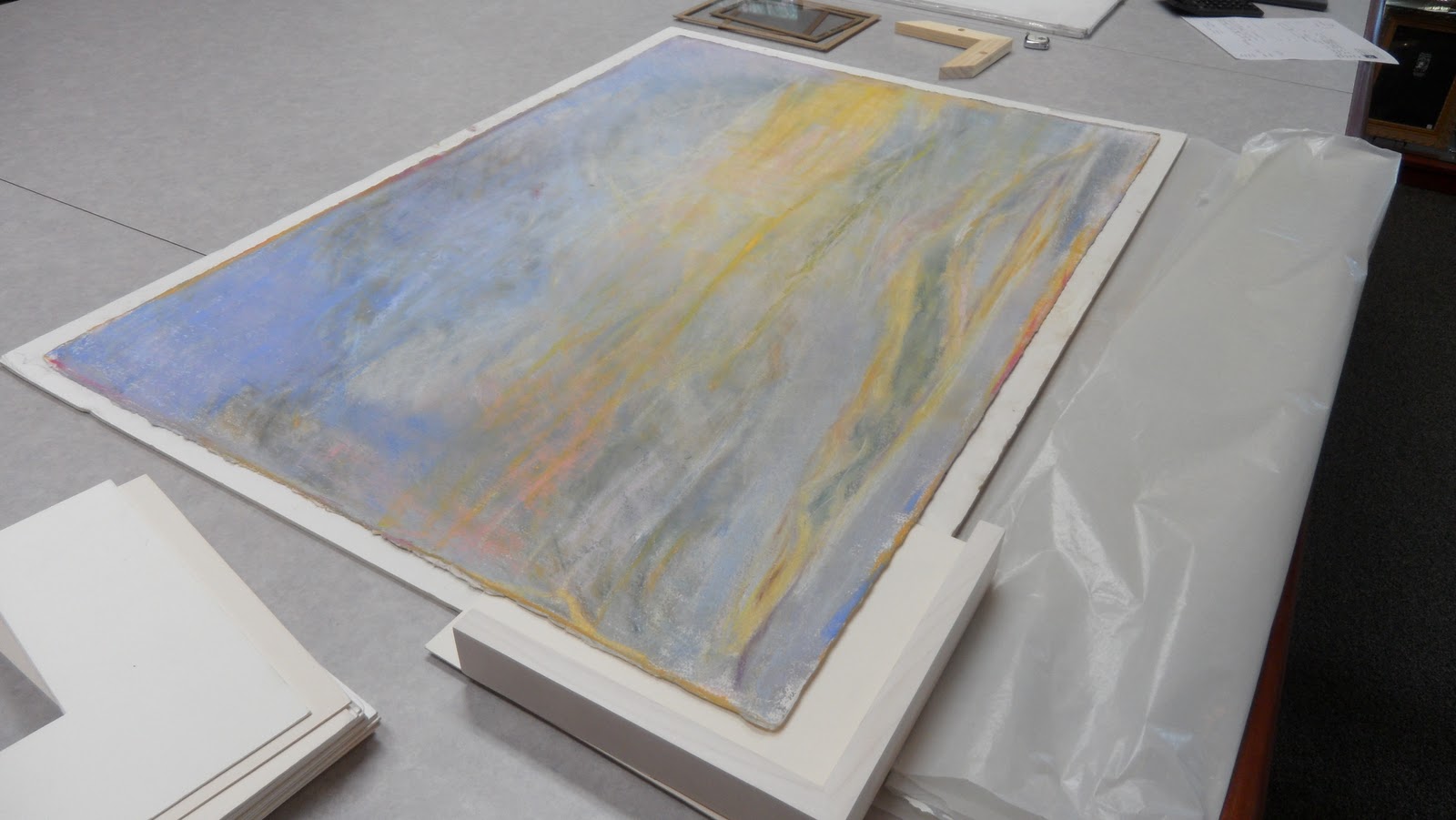
A day of unconventional mail, art again moving through the world and making its effects felt in unexpected places: also received today, from dear Matthew, in California, who taught me to play, a painting. It sat on top of his piano, and the window whose view inspired it was behind me as I sat with my cello. The light on the San Francisco Bay luminous in pastel as the framer carefully cuts it free of the packaging. He looks it over admiringly: "every inch is expressive, is an integral part of the work...." I tell him that if one knows, then this impressionistic light and colour is unmistakably the Bay, seen from the hills to the the east. The rise of Angel Island in the foreground, the contoured mass of Marin in the right-hand background. "I used to live there," he said. "This gives me goosebumps."

Sunday, March 27, 2011

[just wow]

Every so often the musical experience comes along that blows your mind, alters your state of being...tear-inducing and skin-gasm-giving (learned that one from Eddie!). Tonight it was the St Petersburg Philharmonic Orchestra conducted by Yuri Temirkanov and Alisa Weilerstein playing the Shostakovich Cello Concerto No. 1. Preceded by Rimsky-Korsakov's Russian Easter Overture (and followed by Brahms Symphony No. 4 and an encore --hurrah-- from the Enigma Variations, which did something beautiful and delicate at the very end, giving the final pronounced dying note to a violin somewhere at the back). But they had me from the first notes of the Rimsky-Korsakov. The sound of the orchestra was just beautiful -- a completely different experience from the SF Symphony (feel a little bad there resorting to such comparisons). So live -- in the sense that no recording could ever approximate this sound -- a performance that pulls you right there into the present with it, that doesn't just let you listen from the outside, as if through glass or through speakers, but pulls you right there into the music with it.

Lacking much proficient vocab for describing these things, I want to say somehow that their "pronunciation" of the music was different, and that its "posture" was somehow exceptional. Perhaps the pronunciation was the deep and many-sided emotion -- as well as something that I struggle to describe in how the transitions between different kinds of passages seemed to more meaningfully articulated than anything I've heard before. And perhaps the posture is the sense of an unshakable conviction that this was profoundly serious, that the efforts to use all this art form's abundant and varied means for communication and expression and to convey all that these pieces contained -- that these efforts were made with the utmost earnestness and with abandon. In short, I suppose what there was here (or what I was ready to feel) was art, unabashed, unapologetic art.

And, by the time we got to Shostakovich in particular -- art as a matter of life and death, in all its urgency. Weilerstein was tremendous. The Shostakovich concerto is terrifying and ferocious. And so devastatingly subversive. Appropriating music to fit a desired meaning is notoriously fraught (especially in the case of Shostakovich), and although the Soviet authorities found a perfectly acceptable narrative of their own in the concerto, it's impossible not to hear the cello as a biographical subject of the past decades of Stalinist Terror and war that preceded its writing. And that the cello could say what it does with the full support of the ranks, of an orchestra around it -- is somehow visually also deeply subversive. At one point, in one maniacally repeating dance right up high in thumb position, I swear you could actually hear the cello issue a caustic mocking laugh. Even the breaking of a string during the final movement and Weilerstein's departure from the stage to fix it did nothing to diminish the taught, terrible power of the whole. Maybe, like the enigmatic, ambiguous, disturbingly strained "sound of a snapped string" in Chekhov's famously obscure stage direction to The Cherry Orchard, it only enhanced it.

Thursday, March 17, 2011

sympathetic vibrations

I wasn't going to practice yesterday, but as I was driving back from a quick errand in the evening, contemplating dinner and Dostoevsky (not to be confused with Dining with Dostoevsky), out of the car radio came some cello notes -- slightly electronic, musacky ones at that, barely real music, but just some filler between programs on NPR, but unmistakably cello -- and that was it -- irresistible seduction; I just had to take out the cello when I got in.

To say something was "pulling at the heartstrings" is obviously a total cliche, but the idea of the soul as something like a stringed instrument goes way, way back...in Plato's Phaedo the attunement of a stringed instrument is a metaphor for man's responsiveness to the divine. And, at the eighteenth century's gentlemanly invitation, "Now if we consider the human mind, we shall find," David Hume tells us, "that with regard to the passions, 'tis not of the nature of a wind-instrument of music, which in running over all the notes loses sound after the breath ceases; but resembles a string-instrument, where after each stroke the vibrations still retain some sound, which gradually and insensibly decays."

One of my early and most thrilling cello breakthroughs (a good many months in) was my discovery of sympathetic vibrations. I may have noted down something about this phenomenon from my Scottish physics teacher's endless dictation in high school, but it doubtless got lost somewhere between the formulae for calculating the elastic extension of springs and the speed of toy trucks rolling down ramps. If it did get a look in in those physics lessons, though, I'm also pretty sure it had more to do with preparing us as engineers of the future who made non-wobbly bridges, rather than as late-blooming cellists.

In short, though, when you play, say, a D on the cello's A string, it will cause the neighbouring open D string to resonate--due to
sympathetic vibrations. The sound has an extra, glorious, quality of ringing resonance. As well as endearing the cello and its voice to me still further, this discovery went a long way at that time in helping me hear and understand how to play in tune. The sympathetic vibrations reach outwards, ringing with the potential to attract other kindred strings and spirits, and drawing the listener-player into their song.

The physics of the matter turns into both a beautiful sound and a powerful image for connection and communion, through music or otherwise.

In Virginia Woolf's long elegiac novel, The Waves, a work intensely concerned with the aural imagination and the aural landscape, Bernard muses as he walks the city streets: “Am I not, as I walk, trembling with strange oscillations and vibrations of sympathy, which, unmoored as I am from a private being, bid me embrace these engrossed flocks?”

Already moved by musical experiences and literary images of sympathetic vibrations--and having sneaked them into my dissertation chapter on the elegy--it was with delight that I came across Elizabeth Le Guin's book: Boccherini's Body: An Essay in Carnal Musicology. Le Guin provides a brief sketch of the history of the soul-as-stringed-instrument metaphor (the examples above from Plato and Hume come from her), and concludes that by the eighteenth century what was new in the use of the metaphor was "its emphasis on the idea of bodies resonating, not only with God or with the organization of the universe, but in
sympathy with one another."

My delight in Le Guin's book was manifold (but this element will make it into the dissertation footnotes; the cello deserves to be in there somewhere, even if covertly.) Now, I actually sat down meaning to tell you about Boccherini's Body (as I have been meaning to for ages), but this will have to serve as a preview of coming attractions....

Friday, August 20, 2010

Music’s Room of Its Own

This month I’ve been having a holiday from my regular cello teacher, and last week I had a lesson with somebody new — the first such experience since beginning to learn two years ago. I enjoyed the lesson, and obviously, as well as the quirk of its firstness, there were differences—different energy, dynamics, approach. I wasn’t looking to find a better teacher or to make a judgment over whom I preferred — I was just curious, and in that sense both the curiosity and I were satisfied.

After the lesson, as we were chatting, the conversation turned to houses and their spaces, and R. spoke of a house (one for sale in Berkeley) with a room so large that it could be a private concert hall… He spoke of the idea with a passionate wonder that made me think his dreams had designed such a space before. My regular cello teacher, and dear friend, Matthew, has also spoken often of spatial fantasies, of a house he dreams of as an ongoing project of the imagination in which no room is too small…

This thought that the two cellists shared reminded me not just of the spaces that music fills, but of the space that music can articulate. There’s a wonderful description of this in Oliver Sacks’ Musicophilia: Tales of Music and the Brain. Sacks quotes from an article appearing in the Guardian by Nick Coleman, an English music critic, who had lost hearing in one ear:
“I imagine that if you like music at all then it has, in your head, some kind of third dimension to it, a dimension suggesting volume as well as surface, depth of field as well as texture. Speaking for myself, I used to hear “buildings” whenever I heard music—three-dimensional forms of architectural substance and tension. I did not “see” these buildings in the classic synaesthetic way so much as sense them in my sensorium. These forms had “floors,” “walls,” “roofs,” “windows,” “cellars.” They expressed volume. They were constructed out of interlinked surfaces which depended on each other for coherence. Musis to me has always been a handsome three-dimensional contained, a vessel, as real in its way as a scout hut or cathedral or a ship, with an inside and an outside and subdivided internal spaces. I’m absolutely certain that this “architecture” had everything to do with why music has always exerted such an emotional hold over me…
I’ve always kept quiet about this architecture business, partly…because I’d never been entirely confident that “architecture” was what I really meant. Maybe “hearing music architecturally” was just me being inarticulate.
But I am confident now. “Architecturally” was precisely right. What I hear now when I listen to music [after losing hearing in one ear] is a flat, two-dimensional representation: flat as in literally flat, like a sheet of paper with lines on it. Where I used to get buildings, I now only get architectural drawings. I can interpret what the drawings show but I don’t get the actual structure. I can’t enter music and I can’t perceive its inner space. I’ve never got much of an emotional hit from technical drawings. This is what really hurts: I no longer respond to music emotionally.” (Sacks, Musicophilia, 159-60.)

This week I also heard other kinds of music fill a particularly beautiful space — the Mather Redwood Grove in Berkeley’s Botanical Gardens. A chance discovery led us to a small concert there by Petracovich and Walking in Sunlight (both pretty great -- natural and honest, gentle and strongly felt).

After walking up to the gardens in the afternoon sun, entering the shady peace of the redwoods was like slipping into a cool, still pool. There truly is something sacred about the redwood trees—transforming all the space below them that their massive height spans into somewhere that feels both perfectly still, but charged with fecundity, ferns breathing fog, motes of life dancing in the sun…

One last thought, which I would not usually mention, as it sounds a little crazy, but seems to belong here with trees and ideas about spatial and textural components of emotional experience: A couple of weeks ago I was walking in Berkeley, in a tree-lined street, not thinking about anything particular (and definitely not under the influence of anything), when suddenly my gaze fell, lightly but with odd intensity on the bark of the tree growing by the road. In that moment, I felt like I had an acute experience of the texture of the wood’s bark, which somehow, and for inexplicable reasons, was suddenly and deeply moving, as if those sensory impressions had completely bypassed rational, conscious or language based ways of perception and cognition…It was as if the sight of pure living texture translated itself into something simultaneously tactile and emotional.

Monday, July 5, 2010

Les voix humaines

"Do you play the cello? ... You have a voice like the voice of a cello."

When I recounted the incident with the stranger who appeared at the beginning of this story/bloggery, putting his abrupt question to me and offering his rationale for posing it, I swiftly added how this, in fact, it is relatively commonplace to observe that the cello's range and tone matches that of the human voice.

But that, of course, takes nothing away from the power and particularity of the cello's voice and the effect of hearing it. There is something not just human (the instrument's size is also a factor) but deeply humane about the sound of the cello. Listening, we soar with the song outwards into the world, and at the same time are drawn inwards to the heart that must be singing. It is melancholy and frank, though capable too of expressing great joy, and possessed of a certain nobility. Behind the sound, in all of its moods, is a sense of something sage, a wise and deep knowing, a fullness of feeling consciousness.

There is something of a clue to the shape of this depth and fullness in the technique (to what degree I may speak of technique--and speak of it I may do more so than enact it!) of playing: from the very beginning my teacher insisted how the motion of making strokes with the bow was a circle. That is, the right arm, drawing the bow across the string, does not just move back and forth across a single plane, but traces a whole circle; thus the sound comes from not just a straight line drawn on a surface, but an embodied shape that fills space.

And, as my teacher pointed out at that first lesson, it is an organic elegance of intersecting circles that makes for the cello's sound: the shape and motion of the arm meeting with the circular surface of the strings and resonating through wood which is not only curved through craft, but which came from the naturally rounded trunks of trees.

Indeed, if the wood of trees could speak, it seems it too might possess the voice of the cello. The special directness with which the cello speaks also seems to project dimensions in all directions: there is this direct connection to its material origins and, at the same time, to its addressees, whose human voices it seems to intone. And then there's the posture of playing this instrument of unlikely proportions, requiring direct and embodied contact. It is not diminished to a mere object simply held by its player, but commands a presence of its own, the cellist approaching the cello as a near-equal in eliciting sound from it.

I wondered where that idea about the human voice and the cello might have been first expressed. I don't know if this was the first expression of it, but in 1636 Marin Mersenne (a French theologian, philosopher, mathematician and music theorist, often referred to as the "father of acoustics") wrote of the viol, the family of precursors to the modern cello:

Without doubt if viols are made truly in proportion they imitate
the [human] voice best of all, and one esteems them too
as having the advantage in representing naturalness best. It
just seems that one cannot refuse the prize to the Viol, which
perfectly imitates the voice in all its modulations, and even the
most important affects of sadness and joy: because the bow
gives the effect of speech, it can maintain sound for a long
time like the breath of the voice, and with it one can imitate
joy, sadness, agility, gentleness and strength by its liveliness,
by its languor, by its speed, by its ease, by its pressure; coupled
with the trills and other niceties of the left hand—which is
the name given to the hand that touches the fingerboard—
representing artlessly the spirit and the charms, [in short]
portraying the grace of a perfect Orator.
[quoted by Lucy Robinson in Early Music, November 1999]

Some months ago, I randomly came across this piece by Marin Marais for viola da gamba called Les voix humaines, from 1701. It amazed me because it seemed to be somehow so very modern. I know tremendously little about early music (and forgive my philistinism) but this piece does not make me think of powdered wigs and staid courtly dances in the way that a lot of it can. In fact, perhaps it seems so modern precisely because doesn't evoke those public courtly occasions, but instead, in its rhythms and its tones, seems to be something far more private--a soul speaking intimately.

Les voix humaines