Showing posts with label Vivaldi. Show all posts

Monday, August 1, 2011

Petersburg's In-Between Spaces


There’s a particular kind of daytime snoozing that I associate with the summertime in St Petersburg – a half- conscious, shallowly immersed, dream-state in which fragments of the surrounding environment and snatches of recent experience float and mingle and expand and contract. I didn't have so much cause to practice submitting myself to this art of lucid dreaming on this visit – for one, the curtains of my room were thicker and more effective at blocking out the midsummer white nights—but the couple of times I have surrendered to a daytime nap, the experience is as vivid as ever. I’m sure this state arises from a combination of the unrelenting daylight, the suspension in a foreign city’s bustle, and the foreign language’s rustle all around and inside. On this trip, at least, I felt some sounds and shapes of Russian a little more internalized than previously. Could this have anything to do with my newly attuned musical ear…? Of course, I’d like to think so, but who’s to know.
In my last week in Petersburg, I went to a concert of organ and cello music. The street address on Sadovaya gave little away about the actual location – it turned out to be set way back from the street, in the grounds of the Suvorovskii-Military Academy, in the Maltese Chapel.
[A Maltese Chapel in Russia? I had no idea…but it turns out that Paul I, son of Catherine the Great, had been made the Protector of the Order of the Maltese Knights of St John in 1797. Paul had grown up reading stories of knights of old, and he went on to develop a particular interest in things chivalric: he endeavoured (with no success or popularity) to reinstitute the honor of the old chivalric orders as an antidote to what he perceived as Russia's corrupt aristocracy. In Petersburg, city of royal palaces, it is a castle--Mikhailovsky Castle--complete with drawbridges and armored knights in relief on its front walls--that was Paul's residence. The Knights of St John were connected to the grail, and ss for the Maltese Chapel--and tales of knights that played on my own childhood imagination--I have to admit that something about the chapel's facade--which you come upon suddenly in a hidden courtyard, seamlessly joined to other buildings--reminded me of Indiana Jones and the Last Crusade and the grail temple carved into the rock (filmed at Petra in Jordan).]

The Maltese Chapel at Sadovaya 26, embedded in the Suvorovskii Military Academy


But I digress…Russian tsars…Indiana Jones…ah yes, Vivaldi…To my delight, among the pieces they played was the Vivaldi cello sonata in Eb minor – one of the sonatas that I had played. This was a new experience for me – hearing something that I knew (and knew only through playing –not something I was already familiar with as a listener). Both this novelty and, perhaps, the very nature of this particular music – the clarity of its phrase structures – made for a different kind of listening experience – one where I was as aware of every note as of the unfolding movement of the whole. Listening to the clear line of the cello was like hearing it draw out of me something that I held whole inside myself. Like knowing the words of a play--not just glancingly familiar but deeply internalized—that you see acted before you.
The semi-conscious lucid dreaming is just one of St Petersburg’s in-between spaces. In this transitional society--definitely still transitional 20 years after the end of the Soviet Union--building work, repair and remodeling are going on everywhere, and building-use, commercial activity and consumer behavior are all in a state of flux. I had two particularly striking experiences of Petersburg's in-between spaces that seemed very much typical of the city's current condition and evolution. It is probably no coincidence, either, that they were both in the company of my young friends -- who have degrees in interior design and environmental design, a specialty that also belongs to and finds much application in today's Petersburg.

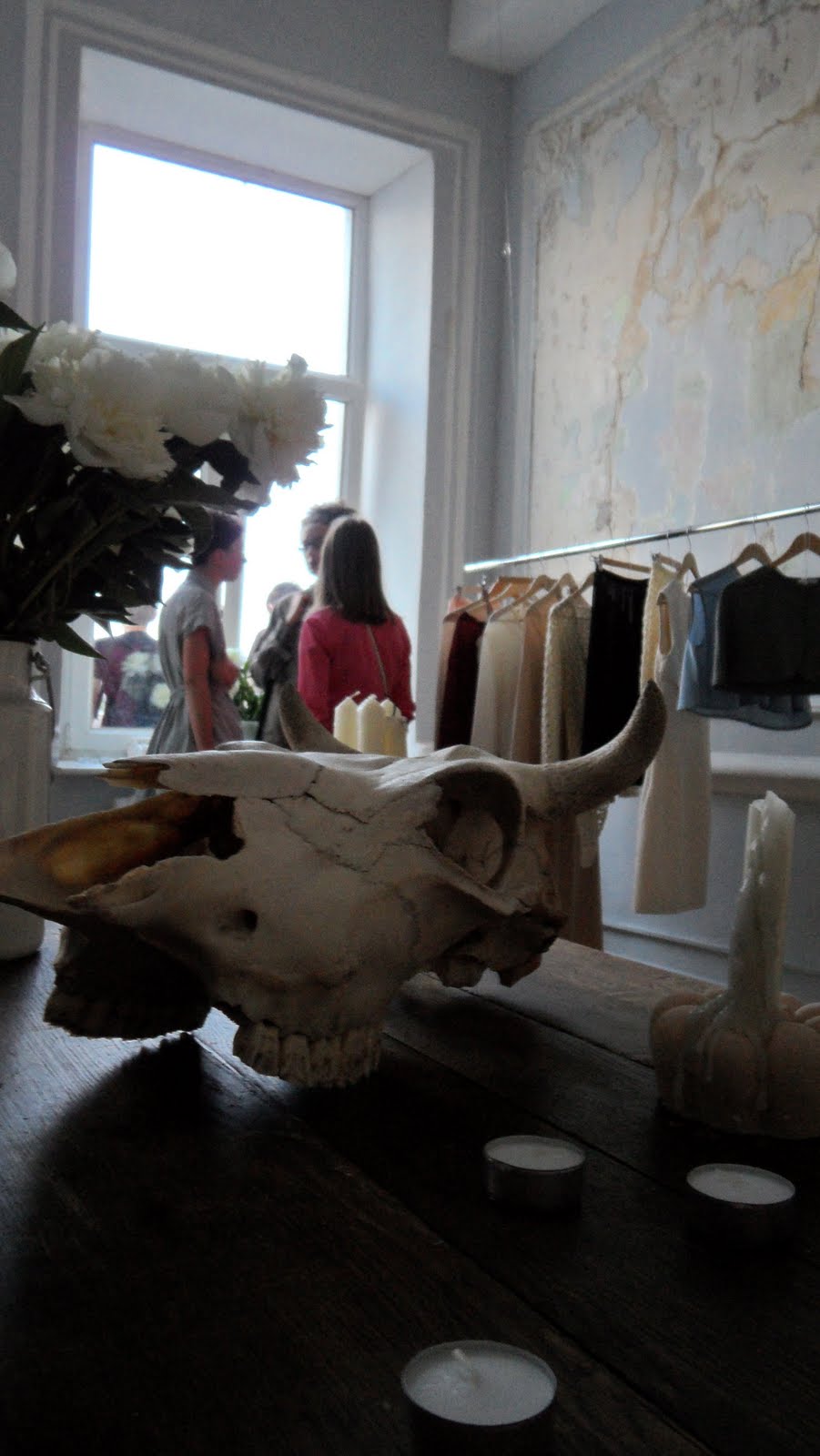
The first was a house -- an unrestored osobniak -- on the embankment right next to the Hermitage. The house was up for sale, but, thanks to its prestigious location and size, at such an enormous cost that it was hardly likely that a buyer would be swiftly forthcoming. So, in the meantime, it was being rented to group of young designers and artists who used the large empty rooms as exhibition and studio space. On my first night in Petersburg, I found myself on its balcony staring right across at the gold spire of the Peter and Paul Fortress against the midnight dusk sky. A party was being held to celebrate one young woman's fashion collection; the clothes were displayed against the flecked walls of peeling plaster, and some time after midnight were hoisted to ceiling-height to make more room for dancing. A couple of weeks later, my interior designer friends took me to their studio. An entrance from the street led up a dingy staircase; we were let into one door and led through a long twisting, high-ceilinged corridor, hung with sheets, and between the seams, every now and then, you could see the building pared down to its bare structural form -- way beyond even the shabby chic of the make-shift fashion exhibition, completely uninhabitable. Then, suddenly, the corridor ended and opened into a large double-sized studio, with beautiful wood floors, fresh paint and all new fixtures. The windows looked onto the yard, and I was completely disoriented as to which way we now faced compared to where we had entered. What will these in-between spaces, and the spaces they are between, have become in another five or ten years, I wonder?




Wednesday, October 13, 2010

Translations

In the world of words, I recently finished--after a lengthy period of abandonment--a short essay to accompany some translations I have been doing from Russian. Translation, before it is an activity of writing, is a particular kind of close reading, where no word can be skimmed over; every word is touched and has its shape felt, including the seemingly inconsequential and unremarkable ones which never elicit any attention. (One of the translator's jobs is to render the text's silences and neutralities as well as the ways in which its style speaks out loud, to ensure that the new text does not attract attention to specific words or formulas that are thoroughly unmarked in the original.)

In the world of music, there is a new Vivaldi sonata in my sights -- No. 5 in E minor. I've tackled the first two movements so far, and have been listening to a recording of them (by Anner Bylsma, but also this one below, with orchestral arrangement). Listening with a view (or an ear) to learning the piece myself, I've realized my attention is different. In a sense, it resembles the kind of reading that proceeds translation: it was listening not just for the overall effect, but for each note and each phrase, attention falling onto every single element. Although I lack the language or the command of music theory to explain them, my sense of musical structures is definitely growing, the more I play and the more I listen with this new kind of attention. Some notes -- ones that I'll have difficulty playing smoothly for the longest -- somehow evade being heard by me -- I just can't quite hear how they fit together, how the individual notes are making the sound I hear. Most often, though, like translation, you can understand the original, hear it, but can't quite find the way of rendering it naturally and fluently. But now it's not facility with language that's the obstacle, but facility with your hands, arms, fingers -- and the way they work in mysterious connection with the inner ear. Translating internally held impression into expression -- which underlies all communicative acts, but the coincidence of these linguistic/literary and musical activities has thrown it into new relief.

In essence, I think the illumination that came anew to me with the translation analogy is this: in translation, you have to truly read every word, nothing of the whole can be omitted or glossed over. And in playing music, regardless of whether it is learning by imitating, or individual interpretation, you truly have to hear and reckon with every single note, nothing can be skimmed over, everything is integral to the whole.

I have been shown, too, new nuances in listening. There is a series of eighth notes in the first phrase of the Largo movement -- 4 repeated Es. But all eighth note Es are not equal. I was originally playing them as statically and fixed as the ticking of a clock, but when Matthew grabbed my cello to play them, now I could hear not just the motion of the growing crescendo, but a motion that articulated connection and forwards movement... How, though, to translate this understanding into a comparable expression through my own body's movements remains slightly elusive... The mystery of the mind--body connection, mediated by the ear, continues to fascinate and mystify me.

Despite that, I can play the Largo reasonably well. The Allegro is proving trickier -- how do I convey to my body that it's my wrist that should be moving the bow on the 16th-note string-crossings, and not my arm...? On the recording, though, I love the passages that are hardest of all for me -- they are ones which give me the feeling of what I would instinctively describe as the movement of biographical time. I remember the first time I felt this profoundly in music when I was a teenager -- not coincidentally, probably, at the age when one is just beginning to become aware for the first time of life's biographical movement... (There's probably something faintly Hegelian here, but that's something to muse on another time, maybe... And hazarding a guess at what, technically speaking, is happening in these moments, I think, maybe, sometimes, at least, they are movements of repeated patterns through different keys.)

Incidentally, the piece I translated -- an experimental semi-autobiographical long essay called "The Return Home" (Возвращение домой) from the 1930s, by the Russian scholar and writer Lidiia Ginzburg, itself has very much to do with the connections between physical and intellectual experience: The sensory experience of the body is revealed, again and again -- in the landscapes she describes (the waters of the Black Sea, the mountain roads of the Caucasus, the long birch-lined roads of the north, the Neva’s embankments) -- as indissoluble from the intellectual and analytical movement of thought. And, like listening to the Vivaldi recordings, in this instance translating actually involved, to some degree, translating from senses or perceptions other than purely linguistic ones: I found myself looking at the sliver of Bay visible from my window, parched grasses under foot, and clouds of fog snagging on the Berkeley hills, in order to find the words that might give expression to the experience of faintly comparable landscapes. It's by coincidence, then, that secretly and ever so slightly underwriting this particular translation from Russian into English is a translation of summer in the Crimea and the Caucasus into summer in northern California...


Wednesday, September 1, 2010

Cello & Chard

I might have discovered, tonight, the bikram yoga technique of cello practice. With the temperature still over 80F at sunset, I decide to bake, in my kitchen that's been lapping up the sunshine all day long, a Swiss chard and goat's cheese quiche--an established favourite, and quite summery, you could say, were it not for the cranking up of the oven that its preparation requires.

The recipe also nicely accommodates a multi-tasking cello-practice (and my practice is always accommodated in my kitchen):
  • blind bake the crust for 10 mins :: warm up with a few scales
  • pause to saute chard for 2 mins (Take care before, during and after this stage to wash hands and keep bow safely out of way of olive oil; the amateur-bloggeur lost her first bow to some wayward sardine oil. Sunflower oil, as readers of Master and Margarita well know, is capable of even more diabolical damage.)
  • bake assembled quiche for 35 mins :: a couple of times through the 4th movement (allegro) of the old Vivaldi Sonata No. 3 in A minor, with special attention to syncopated rhythms and transitions between phrases (I'm prone to just stop).
  • Ping! Remove quiche from oven!
Tonight's post, it should be added, comes with a nod
of acknowledged inspiration to Dining with Dostoevsky.

This was a particularly pleasing practice session; I got through some tricky passages more smoothly than ever. It even elicited some kind words of approval from my long-suffering neighbour who arrived home to hear strains of Vivaldi (and smell of baking) wafting out my open front door. I partly attribute its success to the staggering temperature that my kitchen must have reached during this hour -- all the better for limber limbs and faster fingers, it seems.

Sunday, August 8, 2010

Performance Report!

Yesterday I played the second two movements of the Vivaldi’s Sonata No. 3 in A minor (see/hear below, previous post) and Saint-Saëns' The Swan at the group class / very low key recital that my cello teacher hosts every couple of months. I’ve always been the most novice present on such occasions, but am gradually gaining in credibility and respectability each time. Nerves certainly made for some shaky moments early on, which threaten to uncork general panic and have everything disintegrate, but were eventually overcome. As adults who pursue lives and careers where we use and cultivate our particular skills and strengths, our sense of self probably depends, to some degree, on our valorized competence in specific fields, both professional and personal. So we tend not to find ourselves in situations any more where we publicly (or semi-publicly) struggle with something from far outside those fields that is quite difficult for us. (Doing the long jump on school sports day is safely banished to the past.) But as well as the pleasure of the music itself, it is powerful to find myself doing something of which I had never thought myself capable. (Inspired in part by this sentiment, I'm hoping to volunteer as an adult literacy tutor in Oakland this year; perhaps the "Pen" part of the "Ongoing Composition" can report on this in future.) I have also never felt particularly possessed of physical gracefulness, but in playing The Swan, albeit far from perfectly, I do somehow feel able to command and communicate something approaching that.

I feel nervous about playing the cello in front of these friendly fellow-students not because of their judgment, but because I’m afraid of disappointing myself. And though I’m hardly aiming for a performance career, however well and however much pleasure I gain from playing when I’m alone practicing in my kitchen, or in my lesson, there’s a sense that this only becomes real when you play and other people listen. Or when you play with other people, which is why my threshold for being thrilled here is quite ridiculously low. We began the group class with the six of us playing a simple Schumann chorale—an arrangement into 4 parts of the first piece I’d played in my beginner’s book. Such beautiful harmonies, something grave and sacred, yet so simple. And a choir of six cellos prove that no other instrument is necessary.

In the end, in the second half of the Vivaldi allegro movement (which was probably, in some ways, the hardest of all, at least from the sheer number of notes point of view), I felt more confident in playing and keeping going than ever. This may have had something to do with the fact that on Thursday I had played more than ever before on a single day — practicing both before and after a lesson. And something happened which never had before: afterwards, and especially when I went to bed that night, I could feel the music and the motion in my hands…in the same way you might feel like you’re still on a boat the night after a ferry crossing. I’m sure that’s thoroughly commonplace for musicians who spend hours practicing every day…but to me it seemed quite miraculous—a new, embodied experience of admitting music into my person.

And speaking of cello choirs, playing this (ours was arranged for string orchestra, not just cellos; and no singer—the violins unleashed their inner soprano for our purposes) was a highlight of my summer exploits in the San Francisco Civic Symphony String Orchestra workshop:
Heitor Villa-Lobos, Bachianas Brasilieras No. 5 for soprano and 8 cellos

Monday, July 12, 2010

That rhythm thing

The trusty Feuillard and his Le Méthode du jeune violoncelliste guided me through the first 18 months of playing the cello. Despite the name, this beginners’ method book was well suited to the not so young violoncellist too: our man Feuillard had no truck with Twinkle Twinkle Little Star and the like, but, launches his charges straight into “real” music. The first piece in the book, using just a few notes and extremely simple, was a Schumann chorale. Midway through there came a particular thrill with a Minuet in G major by Bach—(originally for keyboard; familiar to most people who’ve ever learned piano, no doubt: daa da-da-da-da daa da da, daa da-da-da-da daa da da)—and even in the rudimentary way I could play this simple piece, I could somehow discern something of the particularity we associate with Bach, that crystalline form, perhaps.


But since graduating from Feuillard, among the pieces I’ve now been tackling in my lessons are Vivaldi’s cello sonatas, or, rather, to date, Sonata No. 3 in A minor. As respectful of Feuillard as I am, receiving the Vivaldi sheet music in the mail, I felt like a child let loose on the grown-ups’ books. My progress was even confirmed by the pleasingly elegant and newly serious cover. Moreover, YouTube confirmed that “real” cellists played these pieces, and iTunes even sold recordings!

Each sonata is in four movements — largo-allegro-largo-allegro — but each has a decidedly different character. At first this music was all very tricky going for me, but it is thrilling to hear the shapes of each figure and phrase, then each movement, gradually emerge. (Lest this sound as if it is overstating my proficiency, I should add that my threshold for being delighted is very low!)

The past couple of weeks I’ve been concentrating on the second Largo movement, and have become newly friendly with the metronome—as I am, I fear, a little rhythmically challenged, and was prone to a somewhat liberal rendition of this piece in particular. And in terms of the original motivating quest in playing the cello—to discover some new experience of the mind/body relation—having a fluid command of rhythm and really feeling the pulse which underlies the rhythm seem like where that experience lies. Playing along with the metronome or with my teaching marking the beat, some trickily fast passages gave me glimpses (or sensation-impses; felt not seen!) of the fluidity that comes with really feeling the beat and letting it carry the melody along, rather than simply roughly approximating it, or being too influenced by the printed paraphernalia of the music, which sometimes, to an eye used to reading words not notes, can be misleading (I’m sure that sounds as daftly foreign to those who are musical as the suggestion that Russian’s all full of backwards R’s does to a reader of Cyrillic). I suddenly felt like I was speaking fluently, almost as if a stutter had been cured.

One of the enduring wonders and pleasure of music is, of course, its power to evoke and suggest different emotions and different emotionally coloured narratives, scenes or shapes of experience. The second Largo of this Sonata No. 3 seems especially emotionally suggestive (it is indeed marked molto espressivo).

What follows is an experiment to see if I can describe what it seems to suggest to me…an experiment which may be of little interest beyond the process of seeking to describe it…

The first half of the piece piece seems to chart a wistful memory, its transformations and augmentations in time and from different temporal perspectives. The first phrase (beginning with a rising triplet) A-B-C C B-A) sounds a wistful and melancholy memory. A complementary and consoling memory from times further back is added. The memory is traced again, and now a possibility of hopefulness comes in. Hopefulness, resignation and yearning all tug at that memory. Then hopefulness is allowed freer range, and the scale rises; space opens out and there is contentment on sunnier plateaux, newly rediscovered activity contrasting with the slower pace of melancholy reflection, and, then, the dignity of a resolution. ... The final section of the movement somehow makes me think of the story being told from a different, more removed distance, where there is now quiet reflection on the experience whose shape is transformed with distance but still discernibly the same.

And here is the piece of music, played by Italian cellist Enrico Mainardi (1897-1976). (The final allegro movement also follows; I’m still working on this bit :-) ) I picked this recording off YouTube over others because it seems the least “baroque” and the most bare (though other versions with the continuo basso are also very nice).